
State employees do essential work, often for lower salaries than their private sector counterparts. They ought to be paid accurately and on time. But in some States, this isn’t always the case. Alaska is a perfect example. During fiscal year 2025, employees submitted more than 1,500 notices of pay problems. As a result, Alaska is considering outsourcing payroll for approximately 14,000 public employees. This leads to an important question: Is outsourcing the answer to state payroll problems?
Why outsourcing might work for Alaska
Alaska’s payroll difficulties appear closely tied to staffing shortages, making outsourcing a potentially suitable response. According to an October 2026 Alaska Beacon report, a state feasibility study found that 58% of payroll positions were vacant. New employees could require up to a year of training before working independently, making vacancies difficult to fill quickly.
A qualified contractor could provide trained professionals to fill those gaps, clear backlogs, and support demanding payroll periods. Alaska’s proposal seeks to retain existing state systems, an approach that avoids the added complexity of introducing a new payroll platform. But it’s not a one-size-fits-all solution. Other states may require a different approach.
In Dallas, for example, during the 2023 financial management system rollout, employees experienced inaccurate or missing payments. An independent consultant identified shortcomings in planning, testing, communication, and IT involvement, alongside migration and reporting problems.
In situations like these, changing who processes payroll may leave the underlying problems unresolved. States must first identify the causes of payroll failures to determine whether outsourcing can address them or whether improvements to systems, data, and internal processes are also needed.
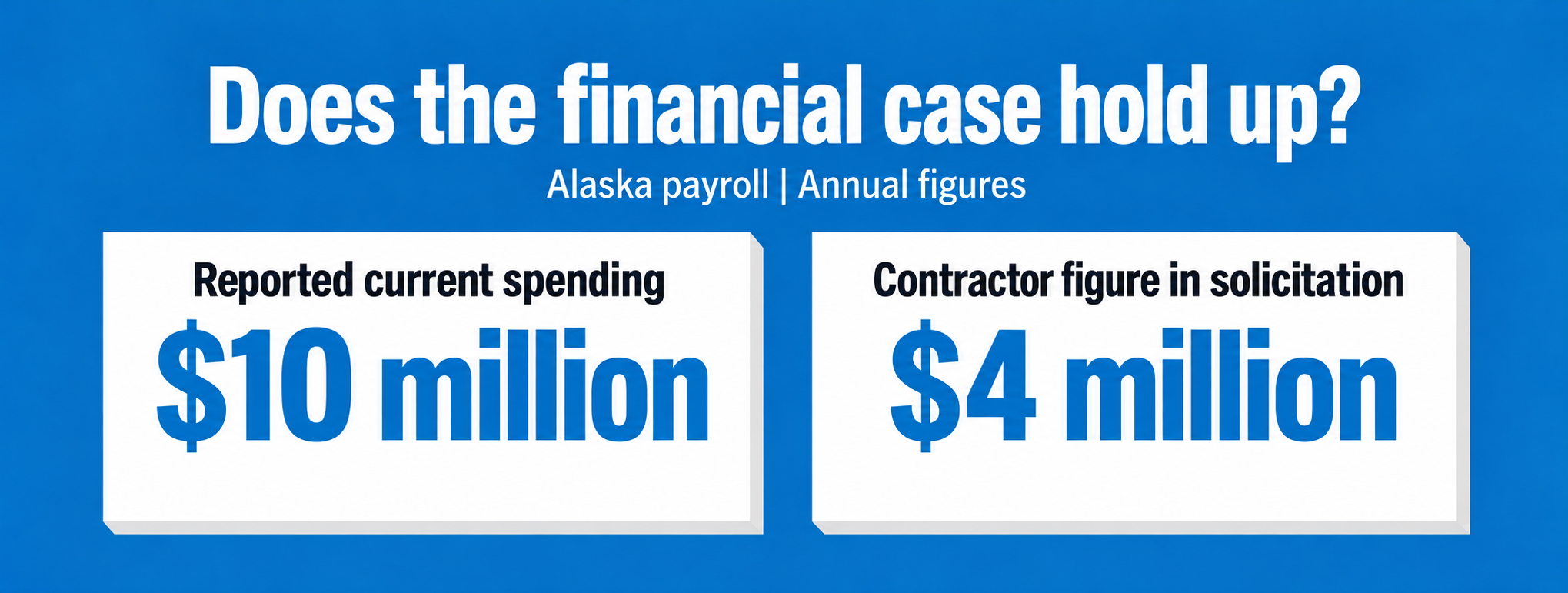
Does the financial case hold up?
Alaska reportedly spends approximately $10 million annually on payroll employees and functions, while its solicitation indicated $4 million annually for a contractor. Those figures suggest potential savings, but they do not establish the final cost once transition expenses, retained oversight, and contractual requirements are included.
Any state considering outsourcing needs to compare equivalent services and account for the full cost of the arrangement. That includes technology, contract management, additional services, and eventual exit costs.
A lower proposed price is one consideration. The financial case also depends on whether the provider can consistently deliver the service employees need.
The transition is part of the solution
Even a capable provider can struggle during a poorly managed handover. Payroll involves accumulated knowledge about employment agreements, historical adjustments, and agency practices. Losing that knowledge can create new problems.
States should preserve experienced staff involvement, document procedures, and reconcile records before transferring responsibility. A phased transition can make problems easier to identify and contain, provided each stage has clear acceptance criteria.
Continuity planning is equally essential. When the December 2021 Kronos ransomware outage affected Fort Worth Independent School District, the district introduced manual timekeeping to help protect payroll. The experience demonstrates why public institutions need workable alternatives when an external service becomes unavailable.
Any outsourcing arrangement should therefore include clear plans for service interruptions, data access, recovery, and the transfer of responsibilities if the contract ends. Also, outside expertise needs internal accountability. Outsourcing does not remove a state’s responsibility for paying its employees correctly. A state needs enough internal expertise to challenge a provider’s calculations, monitor performance, and resolve disputes.
Is outsourcing the answer?
Outsourcing can be an effective solution when payroll problems stem from persistent vacancies, lengthy training requirements, or a shortage of specialist expertise. A qualified provider could offer the capacity and consistency needed to improve service. Outsourcing alone, however, is unlikely to resolve payroll failures caused by unreliable data, unclear processes, or poorly implemented technology.
The strongest case for outsourcing rests on its ability to deliver lasting improvements. State employees deserve accurate pay on time. The right payroll arrangement is the one that can consistently meet this expectation.
